

With Qantas becoming the first Asia-Pacific airline to take delivery of the new Airbus A321XLR, what does this mean for our domestic airlines?
Why is this airliner so important that we think it could bring about a turnaround for India’s largest passenger carrier?
Understanding IndiGo’s Position
Fleet
IndiGo’s fleet is largely dominated by Airbus aircraft, with a total of 434* planes in operation (including 27* aircraft on damp lease). Of these, 48 are ATRs and 13 are Boeings (all on damp lease). The remaining fleet consists of Airbus aircraft. The 27 damp lease aircraft include 13 Boeing airliners.
Damp lease essentially means that a company (lessor) provides its aircraft and crew to another airline (lessee) to operate, while the maintenance, insurance, and other costs are borne by the lessee.
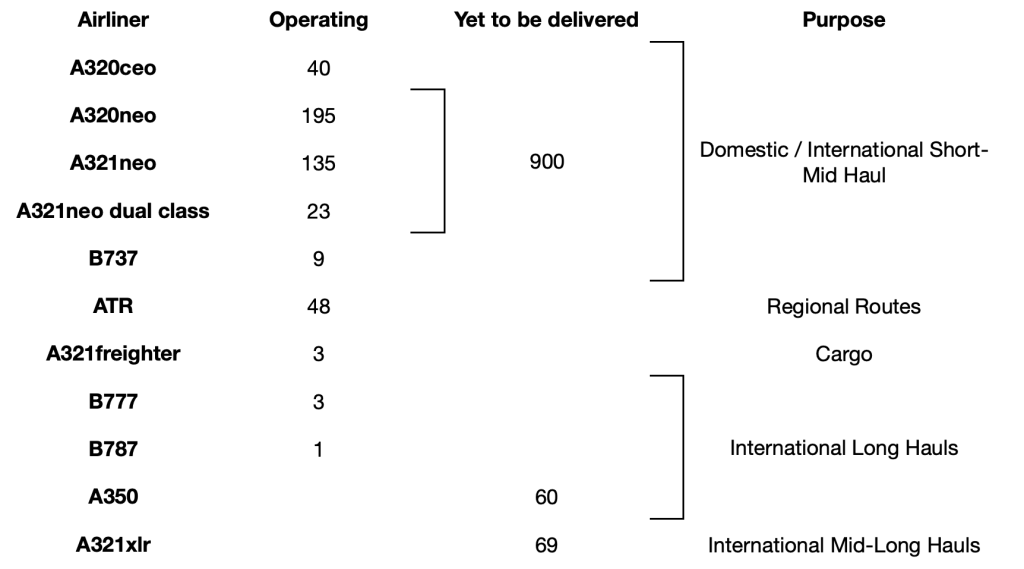
At present, IndiGo operates only 4 aircraft capable of being deployed for mid-to-long haul international flights.
International Presence
IndiGo has been steadily working to expand its international footprint in recent years. Over the past three years, it has increased its international destinations from 25 to over 40. The airline’s international flight capacity is expected to rise to 30% this year, with a target of 40% by the end of the decade. Considering the rapid growth of the domestic market, this increase in international capacity will be significant.
A321XLR vs Wide-Bodied Jets
IndiGo’s future international expansion hinges on two key aircraft types: the Airbus A321XLR and the A350. Let’s compare them:
| A321XLR | A350 | |
| Range | 8,700 km | 15,000 km |
| Fuel Capacity | 32,940 L | 1,66,488 |
| Capacity | 160 to 240 175 to 200 (full range) | 300-350 |
| Fuel Efficiency | No official data yet, but expected to be better | 2.9 / 100 km per passenger |
While the A350 outperforms the A321XLR in range and capacity, the XLR leads in fuel efficiency and acquisition cost.
Why the A321XLR Could Change IndiGo’s Game
A crucial factor for any airliner—beyond its features—is its acquisition cost, whether on lease or purchase.
IndiGo has opted for the A321XLR in a 12 (Business Class) + 183 (Economy Class) configuration, totalling 195 seats. The A321XLR comes at a list price of around $140 million, compared to $317–$410 million for the A350. For a low-cost carrier like IndiGo, this difference is substantial.
The lower purchase price translates to a significantly lower leasing cost as well.
Benefits of the A321XLR
- Serving Low-Demand Routes
- A smaller capacity can be a strategic advantage. High-capacity wide-bodied jets are not always beneficial. Some destinations may not generate enough demand to fill such large aircraft, making operations unprofitable. Here, the single-aisle A321XLR—with its lower operating costs and smaller capacity—can operate at or near full occupancy, improving profitability.
- Alternative Deployment Option
- For certain routes currently served by wide-bodied jets, demand may fluctuate seasonally. During peak months, a high-capacity A350 might be ideal, but during lean periods, it may operate at less than 50% occupancy. Switching to the A321XLR in these months would reduce costs and help maintain route profitability.
- Opening Less Popular Destinations
- IndiGo operates direct flights like Mumbai–Amsterdam and Mumbai–Manchester using wide-bodied Boeing 787s. While these are high-demand routes, there are other destinations in these countries—such as Rotterdam or Bristol—that may not support a wide-bodied jet but could sustain a smaller aircraft. The A321XLR can make such medium-demand routes viable, unlocking hundreds of new international destinations.
- Minimal Customisation Costs
- As a low-cost carrier, IndiGo is not associated with luxury offerings. Operating wide-bodied jets would require significant investment in premium features to meet passenger expectations on long-haul routes. The A321XLR’s smaller size means lower customisation costs, and its efficiency allows IndiGo to offer competitive fares without needing to provide extensive luxury services.
- Lower Risk for New Routes
- The A321XLR’s moderate acquisition cost, long range, smaller capacity, and high fuel efficiency make it ideal for experimenting with new international routes. If a route proves successful, IndiGo benefits from the profits. If not, the airline’s financial exposure remains limited compared to the losses it might face with wide-bodied jets. This also allows IndiGo more time to develop passenger demand on these routes.
- Operational Synergies
- Since IndiGo already operates a large Airbus narrow-body fleet (A320neo, A321neo), introducing the A321XLR will allow for easier pilot training, shared maintenance infrastructure, and streamlined fleet management. This fleet commonality brings significant cost advantages, avoiding the complexities and higher expenses that come with managing a mixed Airbus-Boeing wide-bodied fleet.
Conclusion
The Airbus A321XLR arrives at a critical juncture for IndiGo as it eyes aggressive international expansion. Its unmatched blend of range, fuel efficiency, and lower operational costs gives the airline the flexibility to explore new markets, sustain seasonal routes, and open direct connections to medium-demand cities previously considered unviable. For a low-cost carrier navigating the thin margins of aviation, the A321XLR is not just an addition to the fleet—it could be the catalyst for transforming IndiGo into a formidable player in the mid-to-long haul international segment.
*Fleet numbers fluctuate frequently as new aircraft are inducted and older ones are phased out.
Sources:





 capitalcurrents.co.in
Leave a comment